Did you know that the safety of injectable drugs is guaranteed by using the blood of a single species of crab? When you stop to think about it, this statement becomes increasingly bizarre.
This begs another question: how did this crab make its way into the pharmaceutical industry?
Following this train of thought only brings more questions: what’s so special about this crab’s blood for this industry to use it for decades? What effect does this industry have on the crabs? What will the future look like for these animals, and the organisations that use them?
This article will explore all of these questions and more, by discussing the relationship between science, medicine and the horseshoe crab.
Firstly, what is a horseshoe crab?
The horseshoe crab is, in fact, not a crab. Instead, it is a crab-like animal that shares more in common with spiders and scorpions than the crustaceans it’s associated with. At the ripe old age of 450 million years, they are older than the dinosaurs1.
Four species are found across the world today, but this article will focus on the only species found on the east coast of North America and the Gulf of Mexico: the Atlantic horseshoe crab (Limulus polyphemus) 1 (Figure 1).
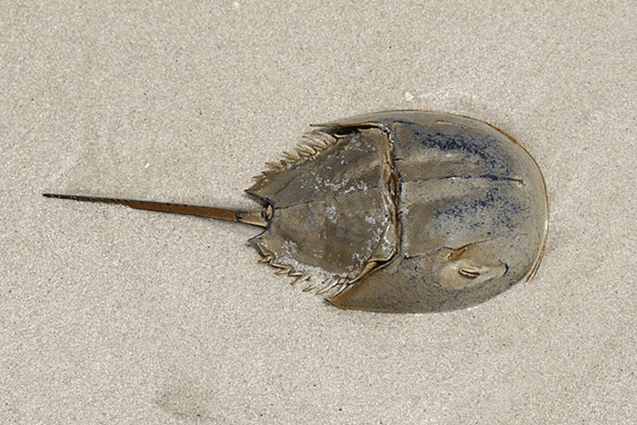
Figure 1: The Atlantic horseshoe crab (Limulus polyphemus). Photo by Stella Fish. Source: iNaturalist, via Wikimedia Commons.
But why the Atlantic horseshoe crab specifically? Simply put, two American researchers in the 1950s discovered a particular feature in the animal’s blood2,3 that eventually became invaluable to the manufacture of myriad medicines.
But more on that later; to understand how important this breakthrough was, we must first learn a little about how injectable drugs and medical devices were originally tested for safe use.
Before crabs, there were rabbits
From the 1940s, the rabbit pyrogen test (RPT) was the standard to test for contamination with pyrogens – substances that could cause fever, inflammation and death if not treated quickly2,4.
When a substance was tested for safety, it would be injected into 3 rabbits. The rabbits’ temperature was then monitored for at least 3 hours. If a rabbit developed a fever (0.6°C or more above their normal temperature), more rabbits were injected to confirm contamination with pyrogens 4. The RPT prevented the use of unsafe batches, but it was not without its problems4,5:
- The exposure of rabbits to illness for the sake of drug testing is an obvious welfare concern for the animals.
- Because of biological differences between rabbits, some reacted more strongly to contamination while others did not react at all. As a result, it was difficult to tell with certainty whether a batch of drugs was truly safe or not.
- Over time, the rabbits show milder symptoms of fever become after several injections.
- Since up to 12 rabbits are required for each test, extra resources would be spent by manufacturers to keep large numbers of rabbits for testing.
Based off these observations, the RPT was actually an unreliable method of testing for pyrogens4.
Therefore, a more consistent alternative was certainly needed. Luckily, it was just a few years later when a solution was found by sheer coincidence.
Blood and Bacteria
In the 1950s, the pathologist Frederik Bang was studying Atlantic horseshoe crabs at the Marine Biological Laboratory, based in Massachusetts, USA. Specifically, he was investigating how these animals respond to infection by injecting them with bacteria taken from seawater. Bang noted how the crabs’ blood would clot after being exposed to Gram-negative bacteria, which is how their immune systems respond to being infected with this type of microbe. He published his findings in 19563.
As a side note: Gram-negative bacteria are bacteria that grow thick cell walls to maintain their shape. The main building block of these cell walls are a type of pyrogen known as endotoxins, or lipopolysaccharides (LPS) (Figure 2), and are shed when the bacteria die. Whilst other microbes make this molecule, manufacturers are heavily concerned about Gram-negative endotoxins because they are well-known for causing immune responses that can lead to death4–7.
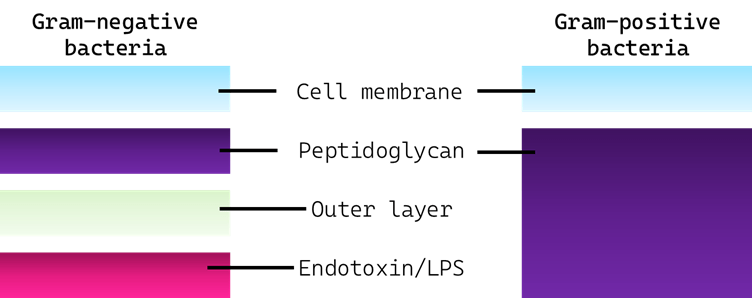
Figure 2: Stylised diagram comparing the cell walls of Gram-negative bacteria and Gram-positive bacteria. LPS – lipopolysaccharide. Image by author, adapted from Malihe Mehdizadeh Allaf and Hassan Peerhossaini (source: Wikimedia Commons).
In 1963, Bang began to work with medical researcher Dr Jack Levin, who was tasked with studying the similarities between two types of immune cell: platelets in humans, and amebocytes in horseshoe crabs. Levin found that the mechanism behind horseshoe crab blood clotting took place entirely inside the amebocytes, and from this research he created the limulus amebocyte lysate (LAL) test. The LAL test addressed the flaws of the RPT: it’s more sensitive to endotoxins, results are more reliable, it’s more affordable than using rabbits, and results are obtained after only 45 minutes3,8.
Even though LAL was shown to be a better alternative, the U.S. Food and Drug Administration (FDA) was reluctant to adopt it for decades, partially because pharmaceutical companies were unwilling to use this new technology3,8, and was yet to be thoroughly tested as a safe alternative to the RPT8.
By 1987, the FDA declared LAL as the gold standard method for endotoxin detection in intravenous fluids, injectable drugs and medical implants3,8. LAL is also used to test for endotoxins in vaccines, gene and cell therapies, and dialysis products 6.
But what about crab welfare?
In order to get LAL, horseshoe crabs are harvested from oceans and beaches, they are drained of up to 30% of their blood under laboratory conditions, and they are returned to the ocean live. Whilst LAL is more effective than using rabbits, the way LAL is harvested negatively impacts the crabs2:
- Firstly, up to 30% of the crabs die after being returned to the ocean.
- Secondly, no-one knows how the surviving crabs are affected by the draining process.
- Thirdly, the ecosystem that these crabs belong to is also impacted. Shorebirds rely on the eggs that the crabs lay as a source of food during their migrations. With fewer crabs to lay eggs, the shorebird population would also shrink.
Once again, an alternative is needed: one that shares the pros of the LAL test and preserves the horseshoe crab population at the same time.
The Solution? Synthetic Proteins.
An alternative to using horseshoe crabs has actually existed since the 1990s, and is a fascinating example of how necessity is the mother of invention.
The first artificial alternative to the LAL test was created by the immunologist Jeak Ling Ding and microbiologist Bow Ho at the National University of Singapore, whilst they were developing the country’s national IVF programme in the 1980s. They saw how the embryos they were growing were dying prematurely, and suspected endotoxin contamination to be the cause. However, they were unable to afford the LAL test kit, and were reluctant to source LAL from the local mangrove horseshoe crab population. As a result, in 1995 they cloned one of the proteins that makes the LAL test as effective as it is: Factor C. The clone was creatively named recombinant Factor C (rFC)6,9.
Now, pharmaceutical companies produce their own synthetic proteins for testing based off rFC, or the entire series of proteins in the crabs that react to endotoxin – known as the recombinant cascade reagent (rCR)6.
Have these alternatives been adopted yet?
Before alternatives like rFC can be adopted by manufacturers, they must first be approved by regulatory bodies that determine the safety standards for medical products2.
For instance, in 2023 the European Pharmacopoeia (Ph Eur) approved the use of rFC to detect endotoxins in pharmaceutical (purified) waters, and high-quality Water for Injections (WFI) – water that certain medications are dissolved in before injection10,11.
Meanwhile, the United States’ US Pharmacopeia (USP) officially permitted the use of rFC and rCR in 2025; manufacturers are free to use these alternatives if they choose12. Also, because they use the USP’s guidelines, the FDA 2, and the pharmaceutical companies that follow the FDA, will likely do the same.
So, there you have it: a brief history of how a crab came to carry an entire industry on its tiny armoured shoulders, and how the adoption of new technologies has started to lighten the heavy load.
Further reading:
- Luo Z, Miao F, Hu M, Wang Y. Research Development on Horseshoe Crab: A 30-Year Bibliometric Analysis. Front Mar Sci. 2020 Feb 11;7.
- Whitney K, Crunelle J. Horseshoe crab blood is vital for testing intravenous drugs, but new synthetic alternatives could mean pharma won’t bleed this unique species dry [Internet]. The Conversation. 2013 [cited 2025 Nov 19]. Available from: https://theconversation.com/horseshoe-crab-blood-is-vital-for-testing-intravenous-drugs-but-new-synthetic-alternatives-could-mean-pharma-wont-bleed-this-unique-species-dry-214622
- Golden Goose Award T. The Blood of the Horseshoe Crab: Its Improbable Contribution to International Public Health [Internet]. The Golden Goose Award. 2019 [cited 2025 Nov 19]. Available from: https://www.goldengooseaward.org/01awardees/horseshoe-crab-blood
- Burgmaier L, van den Berg J, Gajewi M, Röder R, Reich J, Deutschmann SM. Validation of the Monocyte Activation Test Demonstrating Equivalence to the Rabbit Pyrogen Test. Int J Mol Sci [Internet]. 2025;26(22). Available from: https://www.mdpi.com/1422-0067/26/22/11136
- DEPT. OF HEALTH EAWPHS, FOOD AND DRUG ADMINISTRATION. Bacterial Endotoxins/Pyrogens. Inspection Technical Guides. 1985 Mar 20;
- Tsang J. Horseshoe Crabs Break Free from Biomedical Testing [Internet]. The Scientist. 2025 [cited 2025 Nov 19]. Available from: https://www.the-scientist.com/horseshoe-crabs-break-free-from-biomedical-testing-73214
- Ramachandran G. Gram-positive and gram-negative bacterial toxins in sepsis. Virulence [Internet]. 2014 Jan 1;5(1):213–8. Available from: https://doi.org/10.4161/viru.27024
- Center for Drug Evaluation and Research, United States Food and Drug Administration. Guideline on validation of the limulus amebocyte lysate test as an end-product endotoxin test for human and animal parenteral drugs, biological products and medical devices [Internet]. Rockville, MD: U.S. Dept. of Health and Human Services, Public Health Service, Food and Drug Administration; 1987 [cited 2026 Feb 13]. Available from: https://search.library.nyu.edu/discovery/fulldisplay?docid=alma9998641236507871&context=L&vid=01NYU_INST:NYU&lang=en&adaptor=Local%20Search%20Engine&tab=Unified_Slot&query=sub,exact,%20Endotoxins%20,AND&mode=advanced&offset=0
- Ding J, Navas T, Ho B. Molecular cloning and sequence analysis of Factor C cDNA from the Singapore horseshoe crab, Carcinoscorpius rotundicauda. Mol Mar Biol Biotechnol. 1995 Apr 1;4,:90-103.
- European Directorate for the Quality of Medicines & HealthCare. Ph. Eur. allows the use of recombinant factor C for control of bacterial endotoxins in water monographs [Internet]. European Directorate for the Quality of Medicines & HealthCare. 2023 [cited 2025 Dec 8]. Available from: https://www.edqm.eu/en/-/ph.-eur.-allows-the-use-of-recombinant-factor-c-for-control-of-bacterial-endotoxins-in-water-monographs
- COMMITTEE FOR PROPRIETARY MEDICINAL PRODUCTS (CPMP), COMMITTEE FOR VETERINARY MEDICINAL PRODUCTS (CVMP). NOTE FOR GUIDANCE ON QUALITY OF WATER FOR PHARMACEUTICAL USE. The European Agency for the Evaluation of Medicinal Products. London, England; 2002.
- USP. Expert Committee approves endotoxin testing using non-animal derived reagents [Internet]. USP. 2024 [cited 2026 Feb 1]. Available from: https://www.usp.org/news/expert-committee-approves-endotoxin-testing-using-non-animal-derived-reagents


Leave a comment