The vaginal speculum is a device known to many, and those who have been to a cervical cancer screening have a particular relationship with it. What may be lesser known is the history behind its design. As a result, this article will attempt to give a brief timeline of the speculum, from its dark past to its potentially bright future.
Firstly, what is a speculum?
The speculum is a hand-held instrument inserted into the vagina by a medical professional – typically doctors or nurses – to make looking at the cervix easier, or to take samples from the area for further study1.
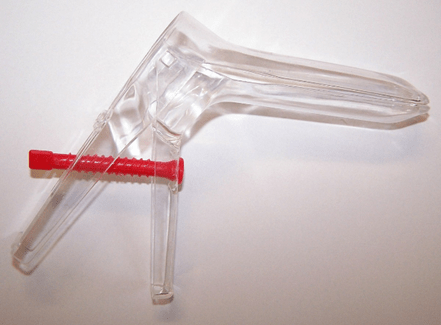
Figure 1: A modern vaginal speculum, made of plastic in the common duck-bill design. Image by Ceridwen~commonswiki via Wikimedia Commons.
For all who enjoy learning about words and their history, speculum comes from the Latin word specere, meaning “to look”1,2. The device definitely lives up to its namesake.
Who designed the speculum?
Some of the earliest known examples of the speculum have been found in Pompeii1, but the inventor(s) are lost to time. They did leave behind some unique designs, like the example below with three blades. A winged bottle opener comes to mind when looking at it.
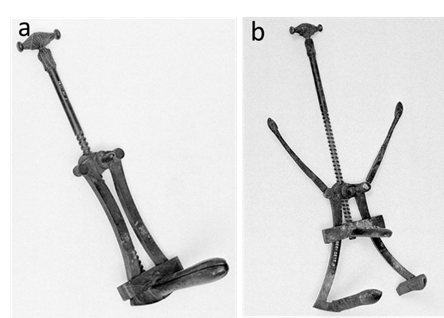
Figure 2: Three-bladed speculum made from bronze, when closed (a) and opened (b), found in Pompeii. Image by the Wellcome Collection via Wikimedia Commons, edited by author.
The origins of the modern speculum are often attributed to the American surgeon James Marion Sims. However, he did not create the version that many would think of.
Sims developed the speculum to properly see and treat vesicovaginal fistulas3, which are tunnels that form when the bladder and vagina are pressed together over time. Before Sims created the design that was eventually named after him, vesicovaginal fistulas were thought to be almost untreatable3. In 1845, Sims created the first prototype using a bent pewter spoon at his hospital in Montgomery, Alabama; by 1849 he eventually refined it into a double-ended design with two blades of different sizes4,5. However, to reach this final design Sims experimented on 12 enslaved Black women; Sims bought these women from their owners and kept them in his hospital5. According to Sims’ biography, only 3 women are mentioned by name: Anarcha, Betsey and Lucy5. Even though the Sims speculum was key to a breakthrough in women’s health, it is deeply unfortunate that this is how it was achieved.
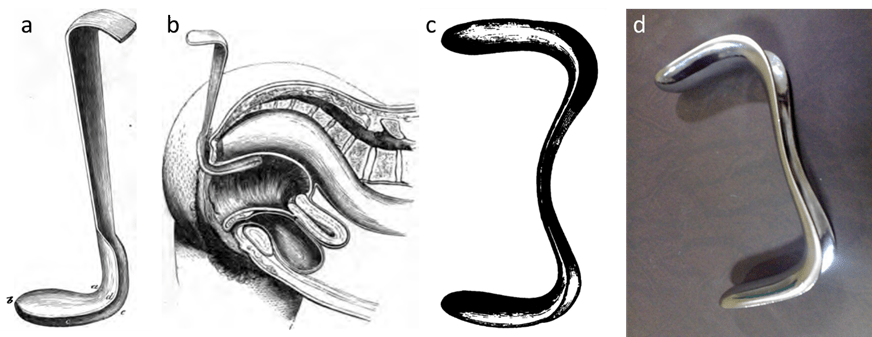
Figure 3: The Sims’ speculum, created by J. Marion Sims in 1845. The prototype, made from a bent metal spoon (a), demonstration of the prototype being used (b), the final design (c), and a modern example (d). Images (a, b, c) from J. Marion Sims 4; image (d) by by Sarindam7, Wikimedia Commons. All images edited by author.
Eventually, the speculum that most people know of was introduced by another American doctor named Frank W. Graves in 18786,7.
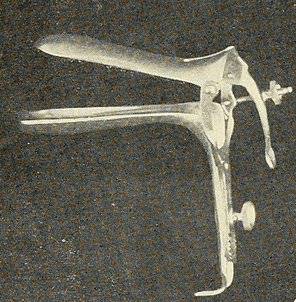
Figure 4: The Graves duckbill speculum. Image by Internet Archive Book Images, Wikimedia Commons, edited by author.
Are there any problems with the current design?
Many people who have experienced the speculum today often mention how uncomfortable and painful it is, with obese patients suffering in particular. Also, when the speculum is opened inside some patients, the sides of the vagina can cave inwards, which then makes seeing the cervix difficult for the physician8.
To address this, several alternate designs have been made over the years. Some of them include:
- The Veda Scope, a dilating speculum first studied by Anna Thomas and her team in 2001, at the Sydney Centre for Reproductive Health, Australia. The Veda Scope was studied again by Peter Longmore at the Werribee Mercy Hospital, Australia9,10.
- The FemSpec, an inflatable, tube-shaped speculum created by FemSuite in San Francisco in 20051.
- The OneSpec, another inflatable, tube-shaped speculum created in 2023 by five engineering students at the University of California, Irvine (UCI), USA11,12.
- The Bouquet speculum, which replaces the two bills with five petals, made in 2023 by Jean M. Bouquet and his research team at Rocky Vista University, Colorado, USA13.
- Finally, the Lilium, which is a rubber speculum with three petals created in 2025 by industrial design engineer graduate Ariadna Izcara Gual and researcher Tamara Hoveling at the Delft University of Technology, Netherlands14,15.
So why aren’t any of these redesigns being used now?
The most common explanation seems to be: most medical professionals are not willing to use devices that haven’t been tested first in multiple clinical trials1,8,16. Clinical trials for newer speculum designs are needed to see if they’re safe to use on patients, to see if they won’t interfere with pelvic exams, and to make sure they don’t damage samples taken from patients. Unfortunately, there have not been many clinical trials studying these newer devices either, again possibly because physicians are reluctant to use new devices on their patients8.
One way to work around this issue may be to make gradual changes to the current design, so that medical professionals are more comfortable with using them. One example of a redesign could be a pair of “folded steel blades coated in a soft, heat-resistant silicone”, as suggested by Gina Taylor and her team in 2017. This version keeps the recognisable bill shape, but is built similarly to a pair of tweezers: it is pinched closed, put into the patient, and then released to open it16.
Therefore, if doctors are more comfortable with using versions like these, they can be tested in clinical trials, and maybe lead to a gradual replacement of the current design with a more comfortable one.
What will the future of speculum design look like?
It is difficult to tell when the speculum will be replaced with a newer one, because having physicians try different versions on patients seems to be a big challenge in itself. But because researchers have noticed this issue, it can be addressed by developing prototypes that keep in mind the concerns of medical professionals as well as patients. Only when a new design is declared by doctors as safe to use, and praised by patients for comfort, will the current speculum be retired.
Further reading:
- Rossmann JS. Built to spec?: The vaginal speculum as a case study of inadequate design. Ambidexterous [Internet]. 2008 Jan 1 [cited 2025 Sep 1]; Available from: https://ldr.lafayette.edu/concern/publications/nv935328w
- Collins English Dictionary — Complete & Unabridged. Speculum [Internet]. Dictionary.com. 2012 [cited 2025 Oct 15]. Available from: https://www.dictionary.com/browse/speculum
- Marion Sims J. On the treatment of vesico-vaginal fistula. Philadelphia: Blanchard & Lea [Internet]. 1853; Available from: https://doi.org/10.1007/BF01901610
- Sims JM. Clinical Notes on Uterine Surgery: With Special Reference to Management of the Sterile Condition. Robert Hardwicke. 1866.
- Sims JM. Story of my life. New York, D. Appleton and company; 1884.
- Cole HO, Garrett GR. Vaginal Speculum [Internet]. National Museum of American History. 1878 [cited 2025 Sep 3]. Available from: https://americanhistory.si.edu/collections/object/nmah_726664
- Abbot. The London Medical Record. SMITH, ELDER, & CO., 15, WATERLOO PLACE. 1879.
- Wong K, Lawton V. THE VAGINAL SPECULUM: A REVIEW OF LITERATURE FOCUSING ON SPECULUM REDESIGNS AND IMPROVEMENTS TO THE PELVIC EXAM. Vol. 5, Columbia Undergraduate Research Journal. 2021.
- Thomas A, Weisberg E, Lieberman D, Fraser I. A randomised controlled trial comparing a dilating vaginal speculum with a conventional bivalve speculum. Aust N Z J Obstet Gynaecol. 2001 Dec 1;41:379–86.
- Longmore P. Veda-scope: More comfortable than the bivalve speculum and cytologically equivalent. Aust N Z J Obstet Gynaecol. 2004 May 1;44:140–5.
- Griffin J. NIH selects undergraduate winners of 2023 DEBUT Challenge for impressive medical device designs [Internet]. NIH National Institute of Biomedical Imaging and Bioengineering. 2023 [cited 2025 Sep 2]. Available from: https://www.nibib.nih.gov/news-events/newsroom/nih-selects-undergraduate-winners-2023-debut-challenge-impressive-medical-device-designs
- Tso N. Reinventing the Vaginal Speculum: Women’s Health [Internet]. UCI Samueli School of Engineering. 2023 [cited 2025 Sep 2]. Available from: https://engineering.uci.edu/news/2023/9/reinventing-vaginal-speculum-women-s-health
- Bouquet JM, Naji R, Armas C, Roldan V, Selkhi S, Bentley C, et al. An Innovative Design for the Vaginal Speculum. Medical Devices: Evidence and Research. 2023 Sep;Volume 16:211–8.
- FRANCE 24. Netherlands researchers redesign vaginal speculum to ease discomfort [Internet]. FRANCE 24. 2025 [cited 2025 Sep 2]. Available from: https://www.france24.com/en/live-news/20250714-researchers-redesign-vaginal-speculum-to-ease-fear-and-pain
- TUDelft. New vaginal speculum design might motivate women to go for health checkups [Internet]. TUDelft. 2025 [cited 2025 Sep 2]. Available from: https://www.tudelft.nl/en/ide/delft-design-stories/new-vaginal-speculum-design-might-motivate-women-to-go-for-health-checkups
- Taylor G, McDonagh D, Hansen M. Improving the Pelvic Exam Experience: A Human-Centered Design Study. The Design Journal. 2017 Jul 28;20:S2348–62.


Leave a comment