Alexander Fleming is lauded as a hero for his chance discovery of penicillin in 1928. However, penicillin wasn’t available to the general public until the mid-1940s. Why did this happen, and what did World War II have to do with it?
The London Discovery
Alexander Fleming, a microbiologist in St Mary’s Hospital, had spent July 1928 on a family holiday in Suffolk. He briefly interrupted his time off to return to his laboratory, where he was studying the growth of bacteria in Petri dishes. Whilst speaking with a fellow research scholar, they both noticed that one of the dishes was contaminated with mould. Fleming was about to throw it away, but after taking a closer look he uttered, “That’s funny.” 1.
Around the mould was an empty zone, almost as if the bacteria were forbidden from entering 1, 2. After going back to his family to finish his vacation, Fleming resumed work in late September. Fascinated by the fungus, he decided to grow it on more Petri dishes to see how it reacts with other bacteria1. With the help of St Mary’s mycology expert Charles J. La Touche1, Fleming identifies the mould as a type of Penicillium. After studying the ‘mould juice’ that formed the empty zone, he creatively calls it “penicillin” 1, 2.
In 1929, Fleming published his discovery in a research paper3. However, his findings were overshadowed by the popularity of Paul Ehrlich’s Salvarsan and Neosalvarsan4. Discovered 19 years earlier, these drugs were the first successful treatments against bacterial infections deemed incurable, like syphilis4.
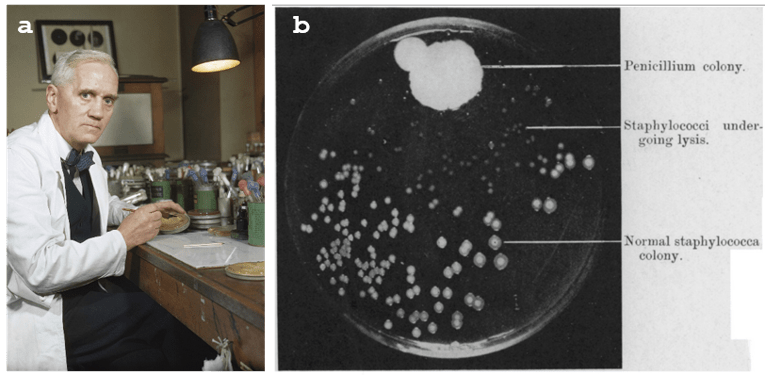
Figure 1: (a) Alexander Fleming in his laboratory in St Mary’s Hospital, London (1943). (b) A Petri dish by Fleming showing the lysis (destruction) of bacteria near a Penicillium fungus.
Image credit: Fleming – Imperial War Museum, Wikimedia Commons. Petri dish – Fleming’s 1929 research paper, via Lalchhandama K1
Fleming also ran into another problem: he couldn’t purify the penicillin1, 2. Neither did he have the expertise to do it himself, nor did anyone in his lab at the time1. With this setback, research ground to a halt. Even when Fleming happily sent his Penicillium mould to any scientists who asked for it, no further progress was made until 1939 2.
The Oxford Isolation
The second wave of antibiotic drugs sets the scene for the next chapter in this story. After the success of Prontosil and other sulfa drugs, the scientific community was eager to find other substances that could treat infections. One member of this community was biochemist Ernst Chain, based in Oxford University. Inspired by Fleming’s 1929 paper, Chain spoke with his supervisor Howard Florey about picking up where that research left off. Luckily, the university already had a sample of Fleming’s Penicillium. Pathologist Georges Dreyer had requested and grew it for his own research in the early 1930s. With the fungus in their grasp, work began at once 2.
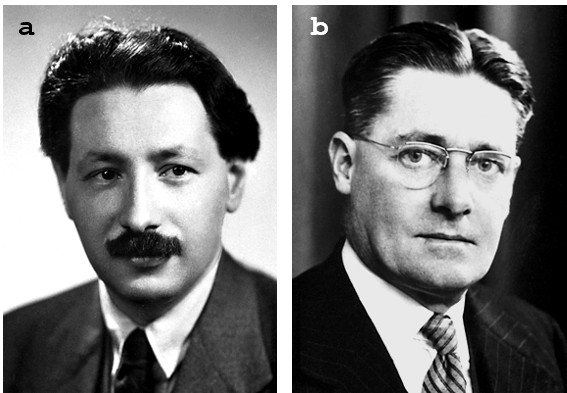
Figure 2: (a) Ernst Chain (1945), (b) Howard Florey (1945)
Image credit: Ernst Chain – Nobel Foundation, Wikimedia Commons; Howard Florey – Nobel Foundation, Wikimedia Commons.
In 1939, Florey brought together a team of experts to grow large quantities of the mould to collect and study penicillin. The team consisted of5:
- Ernst Chain – biochemist; successfully purified penicillin
- Norman Heatley – microbiologist, developed technique to grow Penicillium in large amounts
- Ruth Callow, Claire Inayat, Betty Cooke, Peggy Gardner, Megan Lancaster and Patricia McKegney – the technicians who grew the mould, aka the ‘penicillin girls’
- Arthur Gordon Sanders – operated the penicillin extraction equipment
- Mary Ethel Florey – supervised clinical trials, to monitor penicillin’s safety and effectiveness in humans
- Dorothy Crowfoot Hodgkin – studied penicillin’s molecular structure
- Edward Penley Abraham – biochemist
- Margaret Jennings – research assistant to Florey, determined whether penicillin was toxic
By 1940, the Oxford team showed that penicillin was safe and effective at treating infections in mice. By February 1941, the team treated a small group of patients with great success2. The team’s next step was mass production, but because of their commitment to the war effort, Britain’s pharmaceutical companies did not have the resources to spare. As a result, the researchers decided to seek help from abroad 2.
The Illinois Expansion
In order to mass-produce penicillin, Florey and Heatley collaborated with the US Department of Agriculture (USDA). In June 1941, the pair travelled to Peoria, Illinois with Fleming’s Penicillium culture in tow. The scientists planned to carry it in a vial, but knowing how the fungus could revolutionise medicine, they could not risk it falling into enemy hands. So, at Heatley’s suggestion, the men smeared their coats with the fungus instead2.
Florey and Heatly met with Charles Thom, head mycologist of the USDA, and Andrew Jackson Moyer, head of the USDA’s Northern Research Laboratory. Together they got to work 2.
Under the impression that Fleming’s Penicillium was P. rubrum, Thom found that it was actually P. notatum (now known as P. rubens)1. It was also Thom who understood how important Fleming’s mould was to human health. Thom owned a collection of 1000 types of Penicillium, and found that out of all of them, only one could produce the life-saving drug. So, Fleming was incredibly lucky to find the fungus that could treat otherwise incurable diseases2.
However, the team opted to use P. chrysogenum, found on a mouldy cantaloupe, because it could make 6 times the amount of penicillin compared to Fleming’s Penicillium. Over the next 6 months, Heatley worked with the USDA to find ways of efficiently growing large amounts of the fungus. Meanwhile, Florey spoke with the US government and multiple drug companies to gain support for mass-production. Once the USA entered WWII in December 1941, the US government took over 2. Four chemical and pharmaceutical companies offered their resources6, 7; Pfizer in particular refined their deep-tank fermentation technology to create more penicillin than ever before7.
Within 3 years, the amount of the drug available grew exponentially. In 1941, there was not enough available to treat a single person. But by the end of 1943, there was enough to treat all of the Allied Armed Forces2. Finally, penicillin then became available to the American general public in 1945, and then in the UK in 19466.
The Fleming Myth
Florey and Heatley returned to England in 1942, where the Oxford team were still producing their own modest supply (the US was still experiencing a shortage at this time). In August of that year, Fleming used some of the group’s penicillin to successfully treat a patient with life-threatening bacterial meningitis. The patient’s recovery made headlines in Britain’s national newspaper The Times, but neither Fleming nor Florey were acknowledged for their work. Sir Almroth Wright, immunologist at St Mary’s Hospital and Fleming’s supervisor, wrote to The Times asking for Fleming to be recognised. Fleming himself was happy to be interviewed by the press. However, Florey not only refused, but prevented all other members of the Oxford team from speaking to the media. As a result, the general public were under the impression that Fleming – and only Fleming – was responsible for this life-saving drug. This sentiment is known as “the Fleming myth”2, and is likely why only Fleming’s name is associated with penicillin to this day.
However, the scientific community was well aware of the team effort 2. In 1945, Fleming, Chain and Florey were awarded the Nobel Prize in Physiology or Medicine “for the discovery of penicillin and its curative effect in various infectious diseases”8.
If there is only one message that can be taken away from this moment in history, it’s this: penicillin could never be developed by one person. One moment of simple curiosity turned into collaboration between experts across the world, advancements in technology, and resourcefulness during a time of extreme global pressure. It would understandably take a few years.
Further reading:
- Lalchhandama K (2020) Reappraising Fleming’s snot and mould. Sci Vis 20:29–42
- Gaynes R (2017) The Discovery of Penicillin—New Insights After More Than 75 Years of Clinical Use. Emerg. Infect. Dis.
- Fleming A (1929) On the Antibacterial Action of Cultures of a Penicillium, with Special Reference to their Use in the Isolation of B. influenzæ. The British Journal of Experimental Pathology
- Objects and Stories (2023) The history of syphilis part two: Treatments, cures and legislation. In: Science Museum. https://www.sciencemuseum.org.uk/objects-and-stories/history-syphilis-part-two-treatments-cures-and-legislation. Accessed 8 Jun 2026
- Back From The Dead (2021) Team Penicillin. In: History of Science Museum. https://www.mhs.ox.ac.uk/backfromthedead/exhibition/team-penicillin/index.html. Accessed 20 Jul 2026
- The National Historic Chemical Landmarks Program (1999) The Discovery and Development of Penicillin 1928-1945. American Chemical Society
- Pfizer (2008) Penicillin Production through Deep-tank Fermentation. In: American Chemical Society. https://www.acs.org/education/whatischemistry/landmarks/penicillin.html#penicillin-production-by-deep-tank-fermentation. Accessed 22 Jul 2026
- Nobel Prize Outreach 2026 (2026) Nobel Prize in Physiology or Medicine 1945. In: NobelPrize.org. https://www.nobelprize.org/prizes/medicine/1945/summary/. Accessed 1 Jul 2026
 The Bio//Medical Enthusiast
Leave a comment