Beaks.
One part of the shoulder blade is known as the coracoid process. The word “coracoid” comes from the Greek, meaning “like a crow’s beak”1.
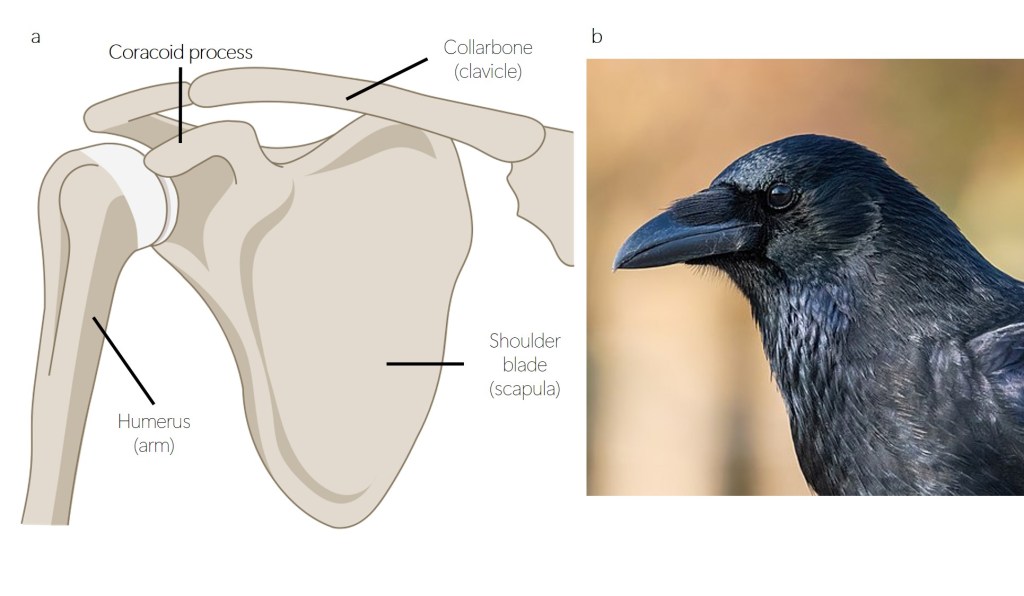
Figure 1: a) Right shoulder blade (scapula) from the front, connected to the collarbone (clavicle) and humerus (one of the bones of the arm, forming the shoulder joint). b) The crow and its beak.
Image created by DataBase Center for Life Science (DBCLS) (a) and Alexis Lours (b). Sourced from Wikimedia Commons, annotated by author.
The coracoid process exists so that two muscles attach themselves to it and function normally: the biceps – which forms part of the arm, and the pectoralis minor – which is found on the chest2.
Note: article updated 1 Oct 2025 to include image.
Further reading:
- Wolters Kluwer. Acland’s Video Atlas of Human Anatomy [Internet]. Wolters Kluwer. 2025 [cited 2025 Sep 7]. Available from: https://aclandanatomy.com/glossary.aspx
- Drake RL, Vogl AW, Mitchell AWM. Upper Limb. In: Gray’s Anatomy for Students International Edition. Second. Churchill Livingstone; 2010. p. 666–94.


Leave a comment